
Quick Summary
Learn how to get the most out of your Indian destination wedding budget by understanding the decisions that have the greatest impact on your wedding.
 Discover why two couples can choose the same resort and budget yet create completely different weddings, how guest count, room blocks, concessions, and entertainment influence one another, where your investment has the greatest impact, and what experienced destination wedding specialists evaluate before a contract is signed.
The guide includes practical comparison tables, real-world planning scenarios, room block strategies, and contract considerations designed specifically for South Asian destination weddings in Mexico and the Caribbean.
By now, you’ve probably already imagined it. The ceremony on the beach in Cancun, the Dominican Republic or Jamaica beneath a beautifully decorated mandap. A packed dance floor at your sangeet. Your family and closest friends together for an entire wedding week instead of just one evening.
You’ve spent hours scrolling through real Indian and South Asian destination weddings on Instagram, Pinterest, and wedding websites, maybe talked with a friend or cousin who had a destination wedding of their own, and researched resorts in Mexico or the Caribbean. You may even have a shortlist already.
You know you want a destination wedding. Now you want to make sure every decision you make from this point forward brings you closer to the wedding you’ve been imagining.
If you’re still deciding on a location, or haven’t started comparing resorts yet, our complete Indian destination wedding planning guide and our guide to evaluating the right destination wedding resort are the right place to start. This guide picks up right where those leave off, at the point where you’re ready to narrow down to a location and resort and want to know how to make that investment count.
Here’s something worth sitting with before you go any further. Two couples can book the same resort, spend close to the same amount, and end up with completely different weddings. Not different in a minor, cosmetic way. Different in the way the entire wedding week felt, both for the couple and for their guests.
One wedding runs smoothly. Guests move naturally from one event to the next, the entertainment keeps the energy high, and every celebration feels intentional. Months later, family and friends are still talking about it. The other, at the same property, with a similar budget, feels more like a series of events that happened to occur at the same resort in the same week.
The difference almost never comes down to how much money either couple had. It’s understanding what each dollar is meant to accomplish.
Your Budget Is More Than Just a Number
Most couples want to know about Indian destination wedding costs in Mexico or the Caribbean early on so they can create their budget. Then, they treat their wedding budget as a ceiling. A number not to exceed.
That’s a reasonable way to think about it early on, when you’re just trying to figure out whether an Indian destination wedding is financially realistic in the first place. But once you’re close to booking a resort, that framing starts working against you, because it treats every dollar the same way, as one undifferentiated pool of money to be spent carefully, rather than as a set of individual decisions, each with its own role.
A destination wedding budget isn’t one number. It’s dozens of smaller decisions that happen to add up to one number. How many guests you invite. How your room block is structured. Which events get a dedicated venue and which get combined. What entertainment carries the week versus what fills a gap.
Every one of those decisions influences the next. Investing more in one area almost always changes what’s possible somewhere else, whether you realize it at the time or not. This is especially true if you want an Indian wedding in Cancun where you’ll find many resorts, vendors, and wedding options.
This matters more for a South Asian destination wedding than it does for a single-day Western wedding, because there’s more surface area for those decisions to interact.
A wedding with one ceremony and one reception has a handful of major budget decisions. A wedding with a mehndi, a haldi, a sangeet, a ceremony, and a reception, spread across several days at one resort, often has dozens, and they don’t operate independently of each other.
A decision made early, like guest count, quietly shapes decisions made much later, like how much flexibility you have for entertainment or décor.
Exceptional weddings aren’t built with bigger budgets. They’re built with better decisions.
That’s what this guide is really about. Not creating a rigid formula or telling you exactly how much to spend on each part of your wedding. Every couple values different things, and every celebration reflects different families, traditions, and priorities.
Instead, you’ll learn how the biggest decisions influence one another, why some investments create far more impact than others, and how to make every dollar work toward the wedding you’ve been imagining.
Same Resort. Same Budget. Two Completely Different Weddings.

Imagine two couples. Both choose to get married at the all-inclusive resort, Moon Palace Cancun. Both invite around 130 guests. Both invest close to $115,000 in their wedding week. On paper, these two weddings should look almost identical. They don’t.
By the end of the week, one couple says it was everything they dreamed it would be. The other says it was beautiful, but there are a few things they’d do differently. Neither couple spent dramatically more than the other. The difference wasn’t the resort, and it wasn’t the budget. It was what happened after they chose the resort.
The First Couple
When they started planning, they assumed every event needed to feel completely distinct from the others. They booked a separate welcome party, mehndi, haldi, sangeet, ceremony, cocktail hour, and reception, each with its own venue setup, décor package, floral installation, and entertainment.
To keep the whole week within budget, they made small compromises throughout, the DJ package stayed fairly basic, transportation between venues turned out to be more complicated than expected, and because their room block wasn’t structured to maximize concessions, they ended up paying out of pocket for several upgrades they had assumed would be included.
By the time they reached the reception, they had a beautiful wedding, and their guests had a wonderful time. But several of the moments they’d originally imagined simply didn’t make it into the week.
The Second Couple
Their budget was almost identical. So was their guest count. They also wanted a full multi-day South Asian celebration.
But instead of treating every event as its own separate project, they looked at the wedding week as one connected experience. Their welcome party flowed naturally into the mehndi, becoming one longer, fuller evening instead of two smaller ones.
Their room block was structured specifically to unlock additional concessions and wedding credits, and those credits covered upgrades the first couple had paid for themselves.
Rather than spreading their floral budget evenly across every event, they concentrated it on the reception, and they chose entertainment built to carry energy across the whole week rather than dividing the budget evenly between events. Nothing about their wedding felt smaller. If anything, guests described it as effortless.
What Actually Changed
Not the resort. Not the guest count. Not the overall investment. What changed was an understanding that every decision affects the next one. Combining two events didn’t just reduce a single line item, it freed up resources that made a much bigger difference elsewhere.
A stronger room block didn’t just lower accommodation costs, it unlocked concessions that expanded what the whole week could include. Simplifying in one place wasn’t about cutting back, it was about creating room to invest in the moments guests actually remember.
This is why experienced wedding specialists at an Indian destination wedding agency like ours rarely look at any one decision in isolation. Guest count shapes the room block. The room block shapes concessions.
Concessions shape what’s possible to reinvest elsewhere. Entertainment changes how guests experience every event on the calendar, not just the one it was budgeted for.
This isn’t a story about one couple making mistakes and the other getting everything right. It’s a reminder that a destination wedding isn’t built one decision at a time. It’s built by understanding how all of those decisions work together.
That’s why two couples can stand on the same beach, at the same resort, with nearly identical budgets, and walk away with two completely different weeks.
And it’s why the most memorable South Asian destination weddings usually aren’t the ones with unlimited budgets. They’re the ones where every dollar has a job and every decision is made while taking account of how it relates to every other decision.
| Decision | The First Couple | The Second Couple |
| Welcome event | Separate welcome party and mehndi | Combined welcome party and mehndi into one evening |
| Room block | Standard booking | Structured to maximize concessions |
| Décor | Spread evenly across all events | Concentrated on the ceremony and reception |
| Entertainment | Basic package | Higher-impact entertainment carried across the week |
| Overall feeling | Beautiful, but a few compromises | Seamless and effortless |
What Most Couples Don’t Realize Before They Say Yes to a Resort

Most couples researching resorts in Mexico or the Caribbean are looking at the right things: the venue photos, the food, the guest capacity, and whether the property has hosted Indian weddings before. What it doesn’t fully prepare you for is what happens once you’ve narrowed things down to a resort or two you love, and you start wondering what it would actually take to book there. That’s the window where many of the biggest decisions get made, often before anyone has even reached out to the resort directly.
What a resort lists online, room rates, package inclusions, standard concessions, is a starting point, not the final picture of what your wedding could look like. Depending on the resort, your guest count, your room block, your travel dates, and the overall size of your group, there can be real room to improve on what’s publicly advertised.
That flexibility tends to be far easier to access when an experienced Indian destination wedding agency is the one making first contact with the resort, rather than a couple reaching out directly and receiving whatever the resort’s standard offer happens to be. And those are just some of the benefits of having a pro on your side from the very start.
Your guest count influences far more than seating charts and catering numbers. It plays a real role in how your room block performs, which can in turn influence the concessions, upgrades, and other benefits a resort is willing to offer.
That’s part of why experienced planners often start talking about guest commitment much earlier in the process than couples expect, not because there’s a wrong way to do it, but because timing can influence what opportunities are still available later in the planning process.
The way events are structured across the week carries a cost of its own, separate from décor or entertainment. Every additional standalone event means an additional venue setup, an additional turnover, and an additional place where something can run late.
None of that is obvious from a resort’s website or marketing materials. It shows up later, in how rushed the week feels, or in costs nobody budgeted for.
Sometimes combining two celebrations doesn’t make the wedding feel smaller. It makes the week feel more intentional while freeing up resources for the moments guests will remember most, the same shift that made such a difference for the second couple.
Perhaps the biggest surprise for many couples is realizing that choosing a resort isn’t the finish line. It’s the starting point. This is where every dollar starts getting a job.
The decisions that come after, how your room block is managed, how your guests arrive, travel between events, and return home, and how those events flow together, often shape the final wedding more than the resort itself does.
None of this means couples can’t get it right on their own. Many do. But the couples who get the most from their investment usually work with a destination wedding agency likes ours early in the process.
Doing so early doesn’t just mean feeling confident about the resort you eventually choose. It means feeling confident you’ve laid the groundwork for the wedding you’re actually hoping to create, starting with that very first conversation with the resort.
The Ripple Effect: How One Decision Changes Everything That Follows
Most couples think they’re making one decision at a time. In reality, almost every decision changes several others.
It’s easy to plan a wedding as though guest count, room block, entertainment, décor, and event flow each live in their own separate box, planned and budgeted on their own. That’s a natural way to approach something this big, but it’s not how any of these decisions actually behave.
Guest count shapes your room block. Your room block shapes what a resort is willing to offer back. Those concessions shape how much flexibility you have for entertainment, décor, or an extra event you’d been hoping to fit in. Every decision creates a ripple.
One decision doesn’t just affect its own line item. It moves through the rest of the wedding.
Guest Count → Room Block → Concessions → Entertainment → Guest Experience
The table below expands on how these ripples play out across a wedding week, and shows how far a single early decision can reach.
| Decision | First Effect | Ripple Effect |
| Choose a different resort | Different policies and concessions from the start | Changes venue flexibility, vendor options, room block benefits, and the overall guest experience |
| Increase your guest count | More hotel rooms needed | A larger room block can lead to stronger concessions, which can free up credit for entertainment, décor, or another event |
| Confirm your guest count early | Your room block fills faster | A fuller room block earlier often gives a resort more reason to extend upgrades or waived fees |
| Combine two events into one | One fewer venue setup | Frees up both budget and time that can go toward the events that matter most to your family |
| Choose entertainment that keeps guests engaged throughout the week | One booking covers more of the week | Creates momentum across the wedding week instead of asking guests to start over at every celebration |
Most couples evaluate each of these decisions on its own, one at a time, as it comes up. Professionals who plan Indian destination weddings every week rarely talk about guest count, room blocks, entertainment, or event flow as separate conversations. They’re all part of the same system.
Once you start seeing your wedding this way, the question changes. It’s less about what something costs and more about what it allows you to create. That’s the idea behind everything in the rest of this guide: every dollar has a job.
How to Make Every Dollar Count
Every dollar has a job. But not every job has the same impact.
Couples often assume every part of the wedding deserves an equal share of attention and budget. In reality, some decisions shape nearly every moment of the week, from the moment guests arrive to the farewell brunch, while others create one beautiful moment inside a single event and nothing beyond it.
Neither is wrong, and both have real value. The difference is understanding which investments ripple across the entire celebration and which ones stay contained to the event they were built for.
The goal isn’t to give every category the same budget. It’s to understand which investments quietly shape the entire wedding week and which ones shine brightest in a single moment.
Most destination wedding packages bundle everything into a single quote, which makes it easy to compare resorts at a glance but hard to see what any one part of that number is actually buying you.
Looking at each part on its own makes it easier to see whether it’s creating a moment guests will remember within a single event, or shaping how the whole week feels.
| Budget Category | What It Shapes | Where the Impact Lands |
| Resort package and room block | The foundation for the entire week, including concessions and flexibility | Touches every event and every guest |
| Entertainment | The energy and momentum guests feel from one celebration to the next | Shapes the memories guests carry home from the whole week |
| Planning and coordination | The timing and flow behind every celebration | Runs through the entire week, often without guests ever noticing |
| Guest transportation | Arrivals, transitions between events, and departures | Shapes the comfort of every traveling guest, every day |
| Food and beverage | Shared meals, hospitality, and cultural traditions | Touches every guest at every event |
| Photography and video | How you’ll relive the week for decades | Lasts long after the celebration itself ends |
| Décor | The visual atmosphere guests remember in photos | Usually lands on one event or one venue |
A breathtaking reception stage may become the backdrop for your photos, but it’s often the DJ, the MC, and a packed dance floor that guests remember years later. Both matter. The difference is understanding which investment shapes a single evening and which one influences how the entire celebration feels.
The weddings you’ve admired on Instagram or at a cousin’s wedding weren’t accidentally extraordinary. They came from dozens of intentional decisions that worked together, the right resort, the right entertainment, the right room block strategy, the right flow between events.
None of those decisions created an unforgettable wedding on their own, but together they created the kind of celebration guests talk about long after they return home. The most memorable destination weddings usually aren’t the ones where every category received the same budget.
They’re the ones where every dollar had a clear purpose, and the categories that shape the whole week were treated accordingly.
Once you can see which categories shape the whole week and which ones create a single beautiful moment, a more useful question comes into focus. Where do couples often invest heavily without getting much back, and where does investing more consistently make the biggest difference in how a wedding feels.
That’s what the next two sections walk through.
Where Couples Invest More Without Creating More Impact
Some parts of a wedding naturally attract more attention during planning because they’re easy to imagine. You can picture the floral mandap, the stage design, or the welcome gifts long before the wedding ever takes place.
But the easiest investments to visualize aren’t always the ones guests remember most. A few categories tend to pull more budget than they give back in how the week actually feels, not because couples are careless with money, but because visibility and impact aren’t always the same thing.
Décor is the clearest example. It’s tempting to give every event its own fully custom floral and décor build, a distinct look for the mehndi, another for the sangeet, another for the ceremony and reception.
Each one looks beautiful on its own, but because décor typically lands on a single event rather than carrying through the week, spreading it evenly across five or six events often means no single moment gets the full impact a couple was hoping for.
Guests rarely remember how many floral installations there were. They remember how a room felt when everyone they loved was laughing, dancing, and celebrating together. A few couples find that concentrating décor investment on one or two signature moments, and keeping the rest intentionally simpler, creates a stronger impression overall than spreading it thin.
Adding standalone events is another place where investment can outpace impact. Each additional event sounds like more celebration, and in a sense it is, but each one also carries its own venue fee, its own setup, and its own draw on the budget, without necessarily adding much to how connected or memorable the week feels to guests.
Many couples discover that combining a welcome party and a mehndi creates one lively celebration where guests naturally meet, reconnect, and settle into the wedding week together. It often feels less like removing an event and more like creating a stronger one.
Over-customizing small details across every event is a subtler version of the same pattern. Personalized touches absolutely have a place, and the question isn’t whether to include them. It’s where they’ll actually be noticed and appreciated. A handful of meaningful details often leaves a stronger impression than dozens spread so thin that most of them disappear into the background.
None of this means these categories don’t matter, or that a couple who invests in them has made a mistake. These investments create beautiful moments. They just don’t usually influence the entire wedding week. Understanding where investment creates less impact naturally leads to the next question: where do the most extraordinary Indian destination weddings consistently choose to invest more?
Where Your Investment Has the Biggest Impact
If some categories create a beautiful moment without shaping much beyond it, a few others work the opposite way. A modest increase in these areas tends to be felt throughout the entire week, by every guest, at every event, not just once. Three areas consistently stand out in the weddings people describe as effortless, luxurious, and unforgettable.
The Moments Guests Remember Most
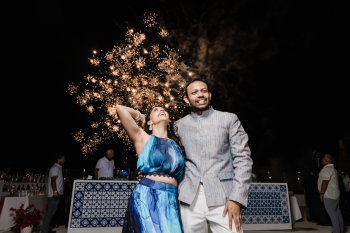 Guests may stop to admire the décor when they first walk into the reception, but years later they’re far more likely to remember the packed dance floor, the laughter during the entrances, and the feeling of celebrating alongside everyone they love.
Great entertainment creates energy. Smooth transportation protects that energy. Guests who move easily from the airport to the resort, and from one celebration to the next, arrive ready to enjoy each event instead of worrying about how they’re getting there.
There are many fun ways to impress your guests such as having fire dancers perform during your sangeet. These are the kinds of experiences you can create that they will truly remember.
For example, Mala and Anush’s destination wedding at AVA Resort Cancun chose to elevate their sangeet night with a fireworks show that had their guests cheering, clapping, and taking pictures making it a special moment for everyone.
The Week You’ll Keep Forever
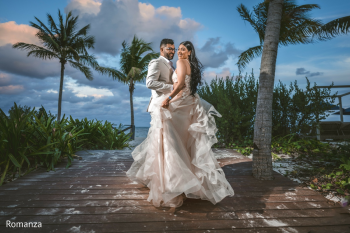 Photos and videos are what a couple actually keeps once the week is over.
A photographer or videographer who understands the pace of a multi-day Indian destination wedding, who knows to be in position for a baraat entrance or a candid moment between siblings during the sangeet, captures a week a couple will revisit for decades.
Unlike a floral installation that’s taken down the next morning, these images become the way a couple relives their wedding week for the rest of their lives.
Sanam and Savanth’s destination wedding at Royalton Splash Riviera Cancun provided the perfect surroundings for their stunning wedding portraits that had an editorial feel, captured by Romanza Photography.
A Week That Feels Effortless
 Planning and coordination are the least visible investments in a wedding week and often the most consequential.
Guests rarely notice when a week runs on time. They absolutely notice when it doesn’t, when one event starts late because the last one ran over, or when nobody seems sure where to be next.
Coordination that keeps every event flowing into the next is what allows all the other investments, the entertainment, the décor, the photography, to actually land the way they were meant to.
This is especially noticeable during the baraat where the resort and wedding planner are coordinating a procession of 150+ guests from one part of the resort to another. Adding in additional elements like smoke bombs, drummers, and DJs, means this is the part of the wedding where it can feel effortless or stressful depending on how well your team pays attention to the details.
Weddings like Khyati and Parth’s at Generations Riviera Maya and El Dorado Royale featured a vibrant baraat with smoke bombs, a car, dhol player, and DJ.
Notice that none of these investments work in isolation. Great entertainment benefits from a well-planned timeline.
Photography depends on moments that unfold naturally instead of being rushed. Seamless coordination allows guests to enjoy every celebration without ever thinking about the logistics behind it.
That’s why the most memorable Indian destination weddings rarely feel like a collection of separate events. They feel effortless because every important decision was pulling in the same direction.
Why the Cheapest Resort Isn’t Always the Best Value
By this point, many couples have narrowed their list to two or three resorts they genuinely love. The challenge usually isn’t finding a beautiful resort anymore.
It’s feeling confident that the one they choose will actually deliver the wedding they’ve been imagining, not just look right in the marketing materials.
The quoted package price is usually the easiest thing to compare between resorts, since it’s the one number every resort lists clearly. It’s tempting to treat it as the deciding factor.
But that number rarely tells the whole story on its own, and a lower price on day one doesn’t always mean a lower total by the time the week actually happens.
Imagine choosing a resort that quotes a lower number upfront but doesn’t include venue access for a second event, charges an outside vendor fee for entertainment, or bills separately for transfers between properties.
By the time those pieces are added in, the total can land close to, or even above, a resort that quoted a higher initial investment but included them from the start. The number on the first page rarely reflects the number a couple actually ends up paying.
This is another example of why every dollar has a job. Choosing a resort doesn’t just affect one event. It influences your guest experience, the flexibility of your wedding week, your room block, the concessions available to you, and ultimately what you’re able to invest in the experiences that matter most.
A resort’s true cost is rarely visible in what’s advertised upfront.
None of this means the resort with the higher quoted investment is automatically the better choice either. It means the number a resort quotes upfront is a starting point for comparison, not the whole comparison.
The more useful question isn’t which resort has the lower price. It’s which one gives a couple the strongest foundation for the wedding they’re actually trying to create.
That’s why experienced destination wedding specialists like our team don’t just compare what’s included. They notice what’s missing, ask the questions couples don’t yet know to ask, and understand what each resort actually makes possible before anyone commits to one.
What an Experienced Indian Destination Wedding Agency Notices That Most Couples Don’t
Finding the right resort, and everything that happens once contact is made with that property, is one of the places where using the services of a Indian destination wedding agency like ours by your side genuinely helps the most. This is also where the gap between DIY research and hands-on experience becomes the most obvious.
Every resort’s website and marketing materials look complete on the surface. The room rate is listed, the venue photos are beautiful, the inclusions are spelled out in a neat bulleted list.
What’s harder to see is what’s sitting just underneath that surface, the details that don’t show up until something goes wrong, or the questions that never get asked because nobody knew to ask them.
The difference between a couple evaluating a resort for the first time and someone who has done it hundreds of times is knowing which details matter most once the wedding week actually begins. Here’s the same resort, seen through two different sets of eyes.
| What Couples See | What an Indian Destination Wedding Agency Notices |
| Beautiful ballroom or ceremony venue | Whether the event timeline allows enough time for room turnover |
| Ocean view | Whether the weather backup delivers the same guest experience |
| Great room rate | Which costs, clauses, or exclusions could affect the final investment |
| Generous room block | Whether the concessions are realistic based on the expected guest count |
| Outside vendors allowed | Which vendor categories have additional fees or restrictions |
| Packed wedding week | Whether the timing and transportation keep the week flowing smoothly |
| Wedding package | How each inclusion supports the overall experience |
None of this means a resort is being anything less than upfront, or that a couple doing their own research is missing something obvious. Resorts communicate a tremendous amount of information clearly through their websites and marketing, and most of the time, they do that well.
The difference is perspective. After working with hundreds of clients and planning celebrations across dozens of resorts, a specialist naturally notices patterns, asks different questions, and recognizes details that first-time couples simply haven’t had a reason to learn yet.
Some of that perspective comes from carefully reviewing what a resort offers.
The rest comes from years of working alongside resort teams, planning celebrations across many different properties, and seeing firsthand how similar decisions influence real wedding weeks. It’s experience that’s difficult to gain from browsing a website alone, no matter how closely it’s read.
That’s what couples are really investing in when they work with an experienced destination wedding specialist. It’s thoughtful guidance, a deeper understanding of how resorts operate, long-standing relationships with resort partners, and the confidence that someone is looking at the entire wedding week, not just what’s listed on a website.
Those relationships often create additional value through negotiated rates, thoughtful concessions, and exclusive resort perks, but just as importantly, they help couples make informed decisions with greater confidence from the very beginning.
Before any of that matters, though, there’s a more personal question worth sitting with first.
Before You Move Forward, Ask Yourselves These Questions

Everything up to this point has focused on resorts, proposals, and the decisions that shape an extraordinary wedding week. Before you move forward, take a few minutes to answer these questions together.
There aren’t any right or wrong answers, but the conversations they spark often make every decision that follows much clearer.
When your guests think back on your wedding six months from now, what do you hope they’ll still be talking about?
Which part of the week matters most to your family, not because it’s expected, but because it’s meaningful to the people who’ll be there?
If you couldn’t have everything, what would you refuse to compromise on?
Are you comparing resorts based on the number on the page, or on what each one actually makes possible for the week you’re picturing?
Is every event on your list one you genuinely want, or did a few get added because it felt like what you were supposed to do?
When you look back on your wedding years from now, what decision do you hope you’ll be happiest you made?
You don’t need to have all the answers before your first conversation with a destination wedding specialist. In fact, most couples don’t.
But having these conversations now makes it much easier to build a wedding that reflects what matters most to you, rather than one shaped by expectations, trends, or what everyone else has done.
Once you know what you’re truly trying to create, the final step is making sure the contract in front of you supports that vision.
What to Know Before You Sign a Resort Contract
Now that you have a clearer sense of what you’re actually trying to create, the contract in front of you becomes more than paperwork. It’s the document that either protects that vision or quietly lets pieces of it slip through the cracks.
A well-written contract isn’t just about protecting your investment. It’s about protecting the vision you’ve spent this guide bringing into focus.
By the time a contract reaches the signing stage, most of the important conversations have already taken place. The contract’s job is to capture those agreements clearly, confirm that everyone shares the same expectations, and make sure the wedding you’ve been planning is the one that’s actually reflected on paper.
A few areas are worth a close look before anyone signs.
Protect Your Room Block and Concessions
Room block commitments deserve a closer look, specifically what happens if the block doesn’t fill exactly as projected.
Concession language should spell out precisely what’s earned and at what threshold, not just a general promise of upgrades or credit. And attrition clauses, the penalty a resort can charge if a certain percentage of blocked rooms go un-booked, are worth understanding in plain terms before signing, since they can turn an unfilled block into an unexpected cost.
Confirm the Details That Shape Your Wedding Week
Event timing and turnover windows are easy to overlook on paper but shape how the whole week actually flows, especially with several events on the calendar.
Vendor access is worth confirming in writing too, which categories are open to outside vendors, which require the resort’s own list, and what fees apply either way, since this can quietly affect entertainment and décor plans already in motion.
Transportation, including how guests move between the airport, the resort, and any off-site events, is worth confirming rather than assuming. Even small logistical details can influence how relaxed and enjoyable the week feels for everyone attending.
Understand Your Backup Plans
A weather contingency plan is worth understanding in detail, not just that one exists, but what the backup actually looks like and whether it delivers a similar guest experience.
The policies covering cancellations, date changes, and guest count adjustments matter for more than worst-case scenarios too, since they clarify what happens if an event gets combined or dropped, or if the date needs to move.
None of this requires becoming a contract expert overnight. It simply means knowing which questions deserve answers before you sign.
Couples who have these conversations before signing usually move forward with greater confidence, because they understand not just what’s in the contract, but how it protects the wedding they’re trying to create.
The Decisions Couples Are Happiest They Made
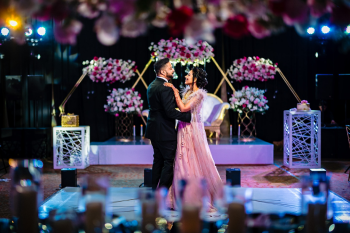
A few months after the wedding, what stays with couples isn’t everything they planned. It’s the decisions they made along the way.
Looking back, couples rarely talk about wishing they’d spent more. Instead, they remember the decisions that shaped how their wedding week felt.
Choosing the resort that fit their celebration instead of the one that simply looked prettier online.
Combining the welcome party and mehndi into one lively evening that brought everyone together.
Investing in entertainment that kept the dance floor full and the energy high.
Keeping the guest list true to the experience they wanted to create.
Having someone ask the questions they didn’t know needed asking before they signed a contract.
Making time to step away together and actually enjoy the wedding week they spent months planning.
Each one reflects a thoughtful decision. The right resort. The right guest experience. The right priorities. The right people to help bring it all together.
Exceptional weddings aren’t built with bigger budgets.
They’re built with better decisions.
Looking back, the couples who love their wedding week most rarely talk about what they spent. They talk about how the week felt, watching both families become one, hearing the dance floor erupt during the baraat, stealing a quiet moment together between celebrations, and seeing their guests enjoy every part of the experience they worked so hard to create.
Those moments don’t happen by accident. They’re the result of thoughtful decisions made long before the first guest ever arrives.
Frequently Asked Questions About Indian Destination Wedding Budgets, Resort Packages, and Spending Decisions

Where should couples spend more, and where can they spend less, in an Indian destination wedding budget?
Spend more on the categories that shape the entire week rather than a single event, the resort and room block, entertainment, and planning and coordination, since their impact reaches every guest at every event.
Spend less by avoiding evenly spreading décor and small personalized details across every celebration, and instead concentrate that investment in one or two signature moments. The goal isn’t to spend less overall.
It’s to make every dollar work harder for the experience you’re actually trying to create.
What are some expenses couples forget to include in their destination wedding budget?
Couples often budget for the resort package and vendors but overlook expenses like attire and alterations, jewelry, welcome bags, gifts for the wedding party and parents, vendor gratuities, beauty appointments, travel insurance, and a contingency fund for last-minute changes.
Reviewing these costs early creates a more realistic destination wedding budget and helps avoid surprises later in the planning process.
What part of the wedding week is most often underestimated when budgeting for an Indian destination wedding?
Many couples focus first on the ceremony and reception, since those are the events they’ve imagined the longest.
What often gets underestimated is everything that connects the week together, guest transportation, entertainment that carries energy from one event to the next, planning and coordination, and the room block strategy that supports the entire celebration.
These investments tend to influence every guest’s experience rather than a single event.
What’s one decision that can affect almost every part of your destination wedding budget?
Not booking your resort and room block early is one of the single decisions that can affect nearly every other part of the budget. The longer a couple waits, the fewer dates, room categories, and concession opportunities tend to be available, which can limit flexibility across the entire week.
Learn more about why you should book your Indian Destination wedding early.
How do I know if my destination wedding budget is balanced?
A balanced budget reflects your priorities rather than a fixed formula.
If most of your investment is going toward the areas that shape the entire wedding week, like the resort, room block, entertainment, photography, and guest experience, you’re generally building a stronger foundation than if the budget is spread evenly across every event and every upgrade.
Can I have the wedding I want without increasing my budget?
Often, yes. Many couples improve their wedding experience not by increasing their investment, but by reallocating it.
Combining events, choosing a resort with stronger concessions, adjusting the guest count, or investing more intentionally in the parts of the week guests experience together can meaningfully change the overall celebration without meaningfully changing the overall budget.
Is it worth hiring a destination wedding specialist before we’ve booked a resort?
This is typically when a specialist adds significant value. Much of the process, finding the right resort, negotiating directly with that property, and setting up the room block and travel logistics, is easiest to influence from the very start.
Once a couple has already booked and paid a resort directly, much of that groundwork is locked in, which limits how much a specialist can still change. Reaching out before contacting a resort, even with just a general destination or a short list of resorts in mind, tends to be the best time to start.
What does working with a destination wedding agency actually look like day to day, and who’s really making the decisions?
Couples typically stay in the driver’s seat on the vision, the guest list, and the overall priorities, while an agency handles the logistics behind that vision, room block management, vendor coordination, contract review, and communication with the resort.
The relationship is closer to a partnership than a handoff, most couples remain closely involved throughout, just without carrying every logistical detail themselves. Take a look at how our process works to see what it is like to work with us.
Can an Indian destination wedding agency really negotiate better resort terms?
Yes, in many cases, an Indian destination wedding agency can negotiate better resort terms. Specialists with established resort relationships can often access room rates, concessions, upgrades, or perks that aren’t part of a standard direct booking. Just as important is knowing which requests are realistic for a given resort and season, and when in the process to make them. It is one of the many reasons why clients choose us.
What usually surprises couples most during destination wedding planning?
Most couples are surprised by how much one early decision shapes everything that comes after it, often more than they expected going in.
A choice made in the first few weeks of planning can still be changing what’s possible months later, which is exactly why this guide spends so much time on how these decisions connect.
Why Choose Indian Destination Wedding
Ready to plan your South Asian wedding in Mexico or the Caribbean? We’ll help you find the right resort for you and bring together all the travel details for you and your guests. And we’ll even connect you with vendors that specialize in South Asian weddings so you can shorten your wedding to-do list.
Please visit our Frequently Asked Questions page, and our summary of average South Asian destination wedding costs.
Learn about different destinations and resorts that have the best perks for South Asian weddings by contacting us online or call at 888-485-0005.


